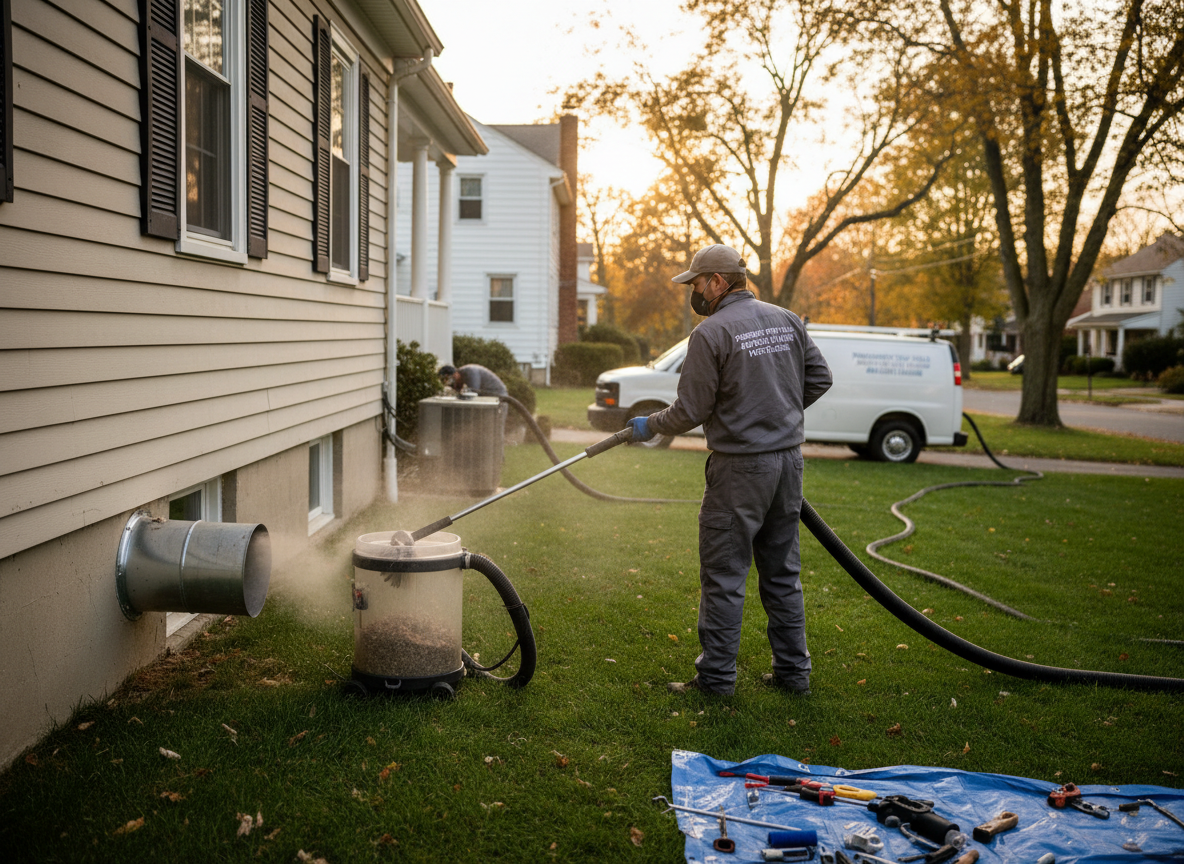
Homes in Parsippany-Troy Hills often feature duct runs installed in the 1960s through 1980s that snake through tight crawlspaces and knee walls common to split-level layouts. These older metal and flex combinations collect fine silt from the surrounding hillsides, especially after heavy spring rains that raise local humidity and encourage condensation inside the lines. Technicians must map each branch before starting because a single missed trunk can leave lint recirculating through the entire system.
Dryer vents in the area frequently terminate near ground level on sloped lots, allowing leaf litter and rodent debris to enter during fall. When these vents share chaseways with HVAC ducts, a blockage quickly pushes moist air back into living spaces and raises the risk of mildew on nearby insulation. Cleaning requires isolating the dryer line first, then using negative pressure on the main trunk to prevent cross-contamination between the two systems.
Access panels are rarely present in local homes, so crews cut minimal entry points at trunk junctions and reseal with code-approved mastic rather than tape that fails in the temperature swings between summer and winter. After vacuuming, each register is tested for balanced airflow to confirm no new restrictions were created during the job.
Technician insight
In Parsippany-Troy Hills, the thing that catches most people out with air duct and dryer vent cleaning is how often 1970s flex duct runs through unconditioned knee walls on sloped lots around Lake Parsippany, where one small tear during brushing lets insulation fibers enter the airstream and requires an extra containment step.
Blocked Dryer Vent in Lake Hiawatha Split-Level
Homeowner reported extended drying cycles and musty smell near the laundry room. Inspection showed the vent shared a chase with the main trunk and had collected leaves and lint where the line exited near grade on the rear slope. Crew isolated the dryer line, cleared the obstruction, and resealed the chase to prevent future cross-flow.
How it works
- 1
Initial Walk-Through
Map every supply and return run, note dryer vent path, and check for visible damage or moisture in Parsippany-Troy Hills split-levels.
- 2
Isolation and Containment
Seal off the dryer line from the HVAC trunk and set up negative pressure to keep debris from migrating into living areas.
- 3
Mechanical Cleaning
Agitate and extract debris from both ductwork and dryer vent using brushes sized for the local pipe diameters.
- 4
Final Airflow Check
Measure register output and dryer exhaust velocity to verify the system moves air at pre-service levels.
Pricing
Upfront quote after inspection; price varies with number of runs, access difficulty, and whether dryer vent shares space with HVAC ducts.