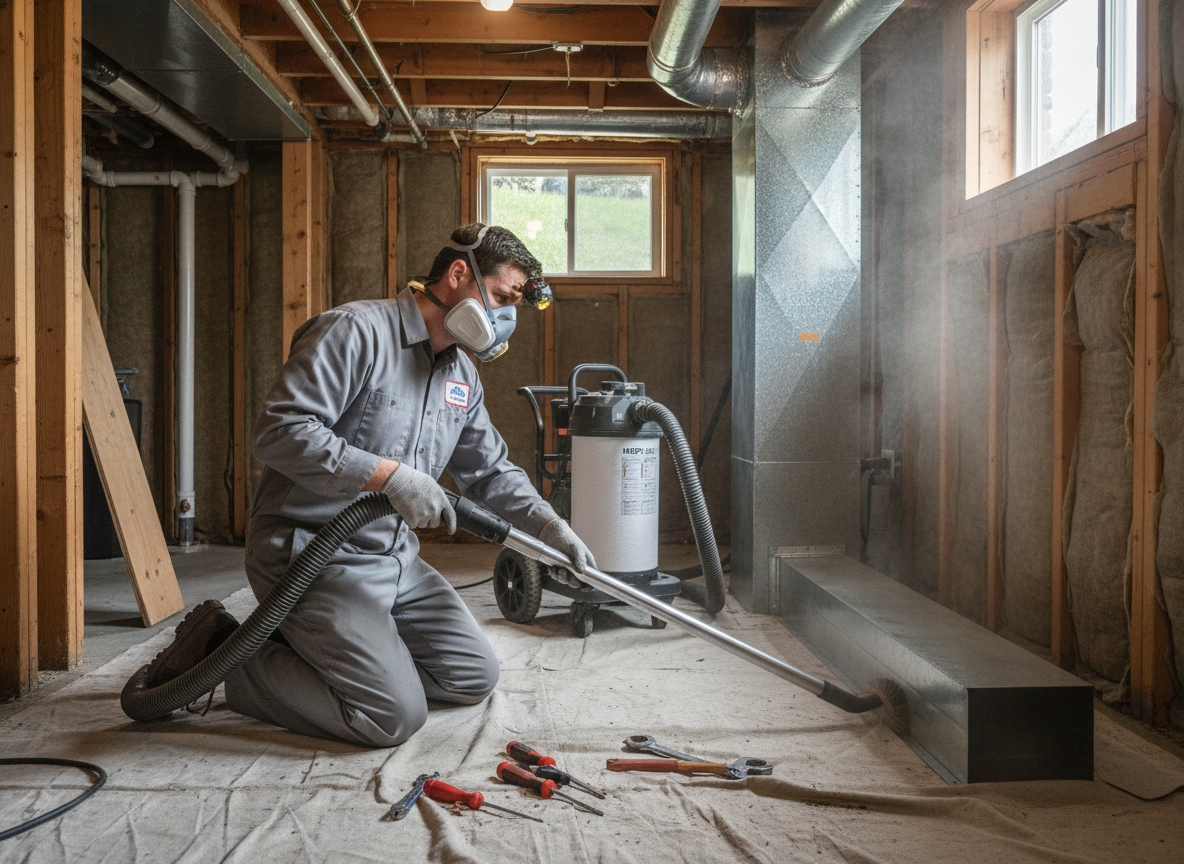
In Parsippany-Troy Hills, many homes built between the 1960s and 1980s use sheet-metal duct runs with unsealed joints that collect construction dust, pet dander, and pollen blown in from nearby open spaces along Route 46 and the Whippany River. Over time these seams allow fine particles to escape into living areas, especially during the humid summer months when the system runs constantly to manage indoor moisture. Cleaning focuses on reaching branch lines in finished basements and crawl spaces where access panels are often missing or undersized.
Technicians start by mapping every supply and return run with a camera to locate blockages or collapsed flex sections common in split-level houses on the hillsides around Lake Parsippany. Negative-air machines are set up at the furnace to pull debris without pressurizing the home, and rotating brushes sized for both rectangular and round ducts break loose the compacted layers that standard vacuuming misses. Special attention goes to the short horizontal runs above suspended ceilings in finished basements where insulation fibers frequently mix with dust.
Edge cases include homes with original asbestos-wrapped ducts near the furnace; these require containment barriers and HEPA filtration before any agitation begins. After cleaning, each register is removed and washed, and the blower compartment is vacuumed to prevent immediate re-contamination. Homeowners are advised to change filters monthly for the first season following service because loosened material continues to move through the system.
Technician insight
In Parsippany-Troy Hills the thing that catches most people out with HVAC duct cleaning is the number of 1970s split-level homes where the return plenum sits behind a finished basement wall with no access panel, forcing us to cut an opening that later has to be patched and painted.
Collapsed Flex In A Lake Hiawatha Ranch
A homeowner in the Lake Hiawatha section noticed weak airflow on the second floor. Camera inspection revealed a crushed flex run under insulation in the attic. We replaced the damaged section, re-cleaned the entire trunk, and restored balanced airflow without disturbing the finished ceilings below.
How it works
- 1
Initial Camera Inspection
Technicians run a scope through every accessible trunk and branch line to document debris levels and locate collapsed or disconnected sections before any equipment enters the home.
- 2
Negative-Air Setup
A high-volume HEPA vacuum is attached to the main trunk while registers are sealed to create directional airflow that pulls loosened material out of the house.
- 3
Mechanical Agitation
Forward and reverse brushes sized for each duct type travel the full length of runs, breaking compacted dust without damaging metal seams or flex connections.
- 4
Register And Blower Cleaning
All supply and return grilles are removed for washing, and the furnace blower housing is vacuumed to clear any material that settled during the job.
- 5
Final Walk-Through
The system is restarted and each room checked for airflow balance while the homeowner reviews before-and-after footage of the ducts.
Pricing
Cost varies by number of runs, access difficulty, and whether flex duct sections need replacement; Mendova Works provides an upfront quote after the camera inspection.