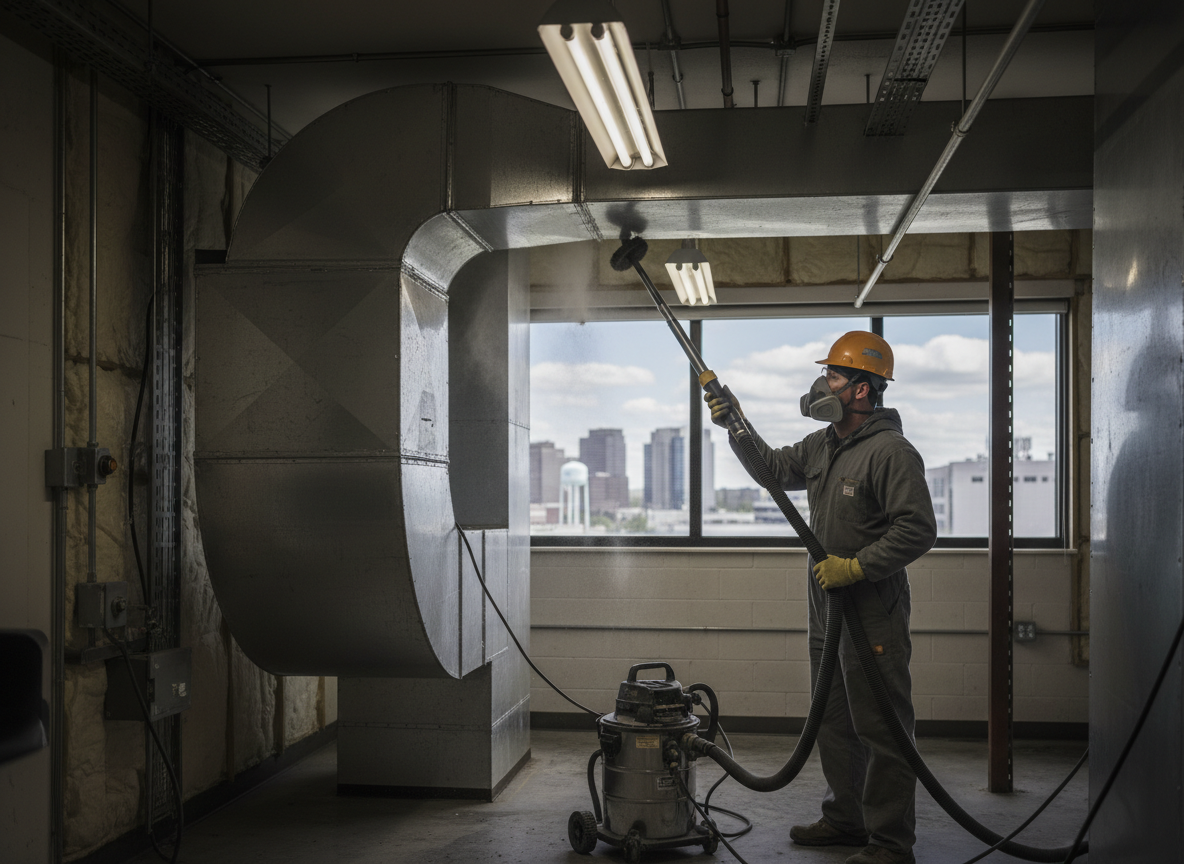
Commercial buildings in Parsippany-Troy Hills often feature larger, multi-zone HVAC systems installed in office parks and retail centers along routes like Route 46 and Route 10. These systems accumulate construction dust, pollen, and office debris over years, especially in structures from the 1970s and 1980s that still rely on original metal ductwork. Cleaning requires accessing rooftop units and long trunk lines that standard residential equipment cannot reach, and technicians must account for drop ceilings and fire dampers that can trap contaminants.
Winter heating cycles in Morris County push warm air through ducts for months, drying out seals and allowing fine particles to circulate into workspaces. Summer humidity adds moisture that can promote mold growth inside supply lines if condensate drains are not maintained. Commercial jobs here frequently involve coordinating with property managers to minimize disruption during business hours, using negative-air machines and HEPA filtration to prevent cross-contamination between tenant spaces.
Older commercial properties near Lake Parsippany and in the Troy Hills section often have mixed duct materials, including fiberglass-lined sections that require gentler agitation methods to avoid fiber release. Technicians inspect for disconnected joints caused by building settling on the area's variable soil and must document airflow readings before and after service to verify system performance for facility records.
Technician insight
In Parsippany-Troy Hills the thing that catches most people out with Commercial Air Duct Cleaning is older office buildings where the original fiberglass-lined ducts have started to shed fibers after decades of winter heating cycles; once that lining degrades you have to switch to gentler methods or risk making the air quality worse.
Office Park Duct Restoration
A multi-tenant building off Route 10 had persistent dust complaints in several suites. Inspection showed disconnected joints in the main trunk above the drop ceiling caused by settling. We isolated each zone, cleaned the lines with rotary tools sized for commercial ducts, and re-secured the joints before restoring airflow.
How it works
- 1
Site Assessment
Walk through the commercial property to map duct routes, identify access points, and note any tenant-specific concerns in Parsippany-Troy Hills buildings.
- 2
System Isolation
Seal off zones and set up negative pressure equipment to contain debris during cleaning of supply and return lines.
- 3
Mechanical Agitation and Extraction
Use rotary brushes and compressed air tools sized for commercial ducts, followed by high-volume HEPA vacuum removal.
- 4
Final Verification
Reassemble components, check dampers, and confirm airflow improvements before returning the space to normal operation.
Pricing
Pricing depends on square footage, number of zones, and duct accessibility; most commercial jobs require an on-site assessment for accurate scope.