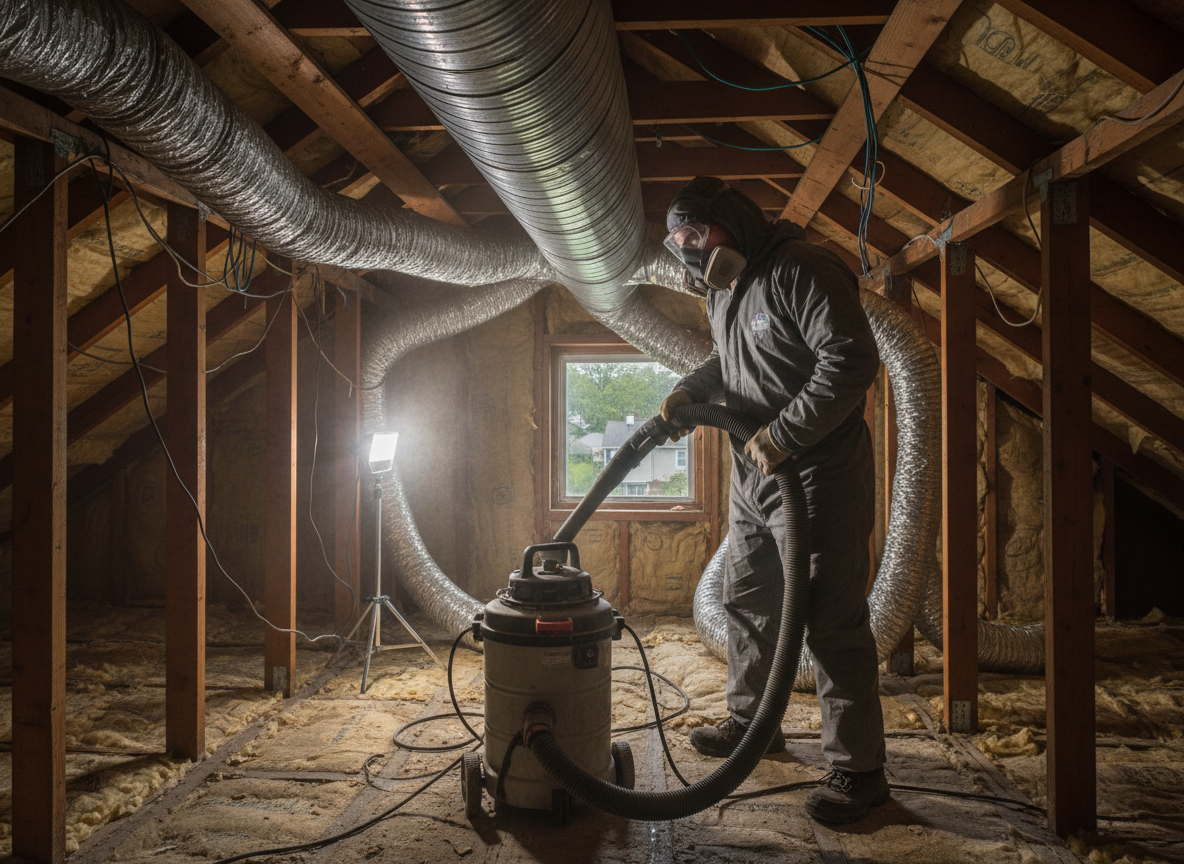
Parsippany-Troy Hills homes built from the 1950s through the 1980s commonly route HVAC ducts through unconditioned attics. These runs collect construction dust, insulation fibers, and seasonal pollen that standard filters never reach. When winter heating cycles start, the debris loosens and circulates through living spaces, raising allergy complaints in neighborhoods like Lake Hiawatha and Mount Tabor.
Flexible duct sections in these attics sag over time and trap moisture from humid New Jersey summers, creating conditions for mold growth along the inner liner. Rigid metal trunks fare better but still accumulate fine particles from nearby construction and road work along Route 46. Technicians must access these lines through attic hatches without disturbing insulation or wiring, a step that requires careful planning in split-level and ranch-style homes common here.
High-static-pressure systems found in many two-story properties push debris farther into branches, so surface vacuuming alone leaves material behind. Proper cleaning uses negative-air machines connected at the furnace and agitation tools inserted at each register to break loose buildup without damaging the duct walls. Homeowners often overlook the return-side ducts in the attic, which pull in the same contaminants and require equal attention.
Seasonal Considerations
Cold snaps followed by thaws cause expansion and contraction that loosens years of accumulated lint inside attic runs. Spring pollen seasons then push fresh material into the same lines, making pre-summer cleaning the most effective window for Parsippany-Troy Hills residents.
Technician insight
In Parsippany-Troy Hills, the thing that catches most people out with attic duct cleaning is how many 1960s and 1970s ranches have flexible duct that sags between joists and fills with insulation fibers every time the furnace kicks on during a cold snap.
Sagging Flex Duct in Lake Hiawatha Home
Homeowners noticed dust on surfaces shortly after turning on heat. Inspection revealed multiple sagging flex lines in the attic filled with insulation and pollen. Crew sealed the system to a negative-air machine, agitated each run, and removed the loosened material without disturbing existing insulation. Airflow improved and visible dust settled after the first full heating cycle.
How it works
- 1
Initial Access and Inspection
Technicians enter the attic through existing hatches and visually check every accessible duct run for sagging, tears, and insulation intrusion.
- 2
Negative-Air Setup
A sealed vacuum system connects to the main trunk at the furnace to pull debris outward while preventing particles from entering living areas.
- 3
Mechanical Agitation
Rotating brushes and compressed-air whips travel each branch line to dislodge material without cutting or puncturing the duct walls.
- 4
Register and Return Cleaning
All supply and return registers in the attic space receive individual vacuuming to clear any remaining residue before the system is reassembled.
Pricing
Cost depends on number of runs, attic accessibility, and whether flexible duct sections need replacement; upfront quotes provided after inspection.