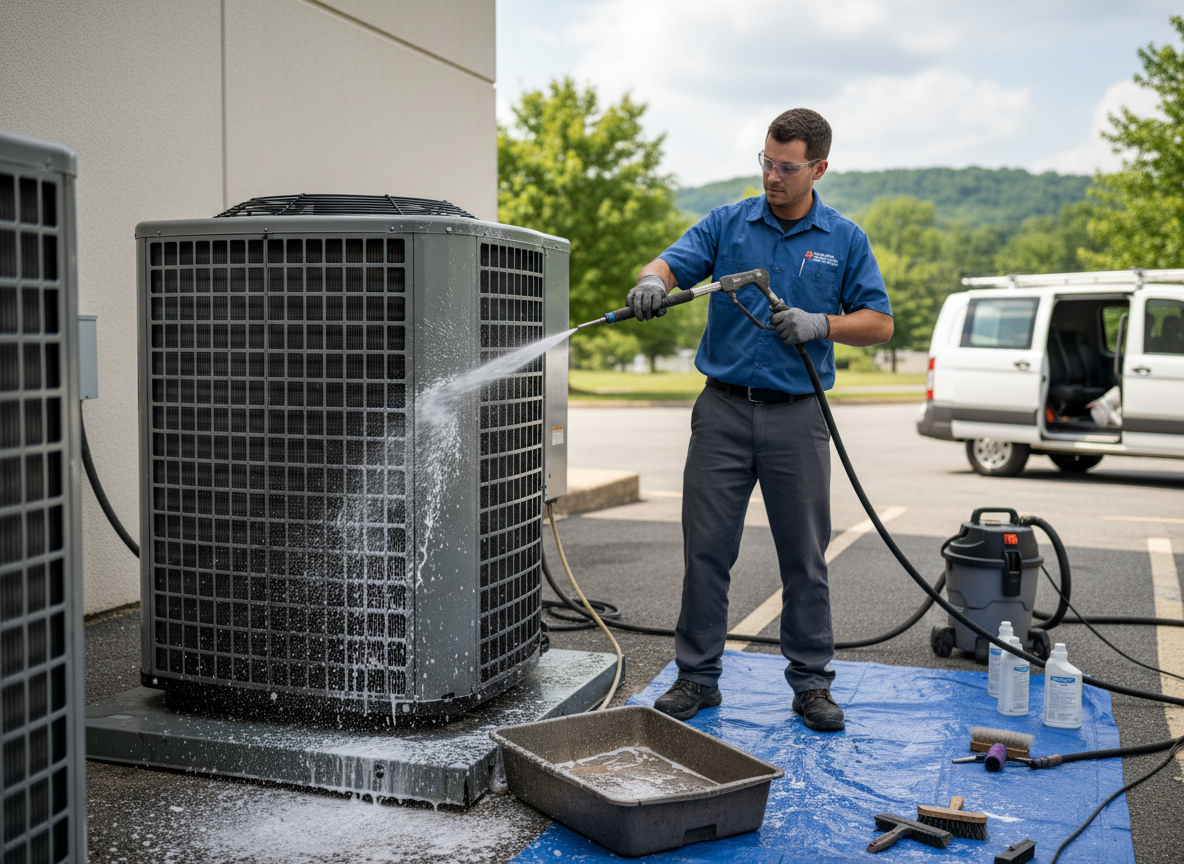
In Parsippany-Troy Hills, evaporator and condenser coils collect pollen, dust, and moisture during the long humid summers common to Morris County. When left untreated, this layer reduces heat transfer and forces the system to run longer cycles. Older split systems in ranch and colonial homes built between the 1960s and 1980s often have tighter clearances, making thorough cleaning slower than in newer construction. Technicians must use non-acidic coil cleaners and rinse thoroughly to avoid damaging aluminum fins or leaving residue that attracts more dirt.
Heating coils in the same systems gather fine dust during the heating season when furnaces cycle frequently. Restricted coils can cause uneven temperatures across rooms in neighborhoods such as Lake Hiawatha and Mount Tabor. Proper cleaning restores airflow without bending fins or dislodging insulation inside the air handler. Homeowners notice the difference in shorter run times once the coils are clear and the condensate drain is verified to be flowing.
Access panels on many local units are secured with multiple screws and sometimes sealed with mastic. Removing and replacing these correctly prevents air leaks that would otherwise pull unfiltered air into the return. After cleaning, static pressure readings confirm the improvement before the system is returned to operation. Skipping this step leaves homeowners wondering why comfort did not fully return.
Coil cleaning is performed with the system off and the blower door removed to reach both sides of the coil. In homes with finished basements common along Route 46, technicians often work in confined spaces and must protect finished surfaces from drips. The job ends with a final inspection of the drain pan and a test of the float switch to ensure no future overflow risk.
Technician insight
In Parsippany-Troy Hills, the thing that catches most people out with coil cleaning hvac is how the 1960s-1980s homes along the hills trap humidity in finished basements, letting mold grow on the underside of the evaporator coil that you only see once the blower is out. Homeowners often run the AC constantly in summer without realizing the drain pan is already partially blocked.
Lake Hiawatha Split System
A 1978 ranch home near Lake Hiawatha had weak cooling on the second floor. Inspection showed heavy pollen and dust on the evaporator coil plus a partially clogged drain. Coils were cleaned, the line cleared, and static pressure dropped to normal range. The homeowner reported even temperatures and shorter run times within two days.
How it works
- 1
System Shutdown and Access
Power is isolated and panels are removed to expose both sides of the evaporator and condenser coils.
- 2
Dry Debris Removal
Soft-bristle brushes and vacuum attachments clear loose dust before any liquid is introduced.
- 3
Coil Application and Rinse
Coil cleaner is applied, allowed to dwell, then rinsed with low-pressure water while protecting electrical components.
- 4
Drain and Final Check
Condensate line is cleared, panels reinstalled, and static pressure is measured to confirm restored airflow.
Pricing
Pricing depends on system access, number of coils, and condition; upfront quotes provided before work begins.