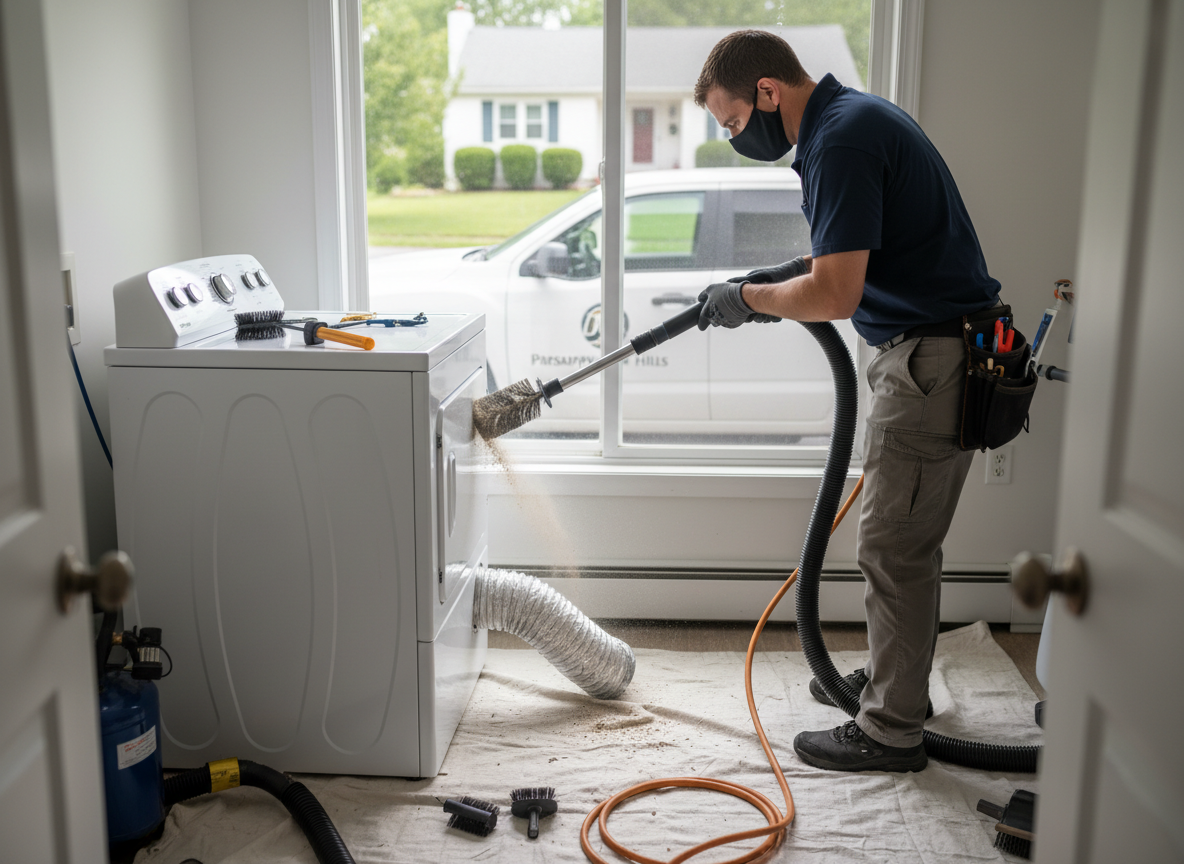
Homes in Parsippany-Troy Hills often feature ranch and split-level construction from the 1960s through 1980s with dryer vents routed through exterior walls or under slabs. These longer runs collect lint at elbows where the pipe turns toward the foundation, especially when homeowners run multiple loads during humid summer months or after winter storms when indoor drying increases. Restricted airflow raises dryer temperatures and forces the heating element to cycle longer, which can shorten appliance life and create fire hazards in older aluminum or flexible duct sections common in the area.
Technicians inspect the full length from the dryer connection to the exterior termination before any cleaning begins. In neighborhoods near Lake Hiawatha or along Route 46, ground-level terminations frequently become blocked by leaves, mulch, or snow, so the process includes clearing the exterior flap and verifying proper exhaust flow once the line is clear. Special attention goes to homes with finished basements where vents travel behind drywall, requiring careful access points that avoid damaging finished surfaces.
After mechanical brushing and vacuum extraction, the vent is checked for remaining debris with a camera scope. This step catches hidden blockages in pipes that run through unconditioned crawl spaces, where temperature swings cause condensation that binds lint into hard clumps. Final testing confirms the dryer reaches proper exhaust velocity without overheating, which is especially important for electric models that dominate local housing stock.
Technician insight
In Parsippany-Troy Hills, the thing that catches most people out with dryer vent cleaning is the long horizontal runs under slabs in 1970s ranch homes, where our freeze-thaw cycles pack lint into hard plugs near the foundation that standard brushes miss.
Restricted Vent in Lake Hiawatha Ranch
The homeowner noticed the dryer taking extra cycles to finish loads. Inspection showed a 22-foot run with two 90-degree turns under the slab that had collected compacted lint. We opened an access point at the first elbow, ran the rotary brush the full length, and cleared the exterior termination blocked by mulch. Airflow returned to normal and the dryer completed loads on the original setting.
How it works
- 1
Initial Inspection
Technician examines the dryer location, vent path, and exterior termination to map the full run and note any access challenges.
- 2
Mechanical Cleaning
Rotating brushes and high-powered vacuum remove lint and debris from the interior of the vent pipe without damaging the duct material.
- 3
Exterior Clearance
The outdoor vent flap and surrounding area are cleared of obstructions such as leaves or snow that restrict airflow in Parsippany winters.
- 4
Flow Verification
Camera inspection and airflow test confirm the vent is fully clear and the dryer exhausts properly before the job is complete.
Pricing
Cost depends on vent length, number of elbows, and accessibility in the home.