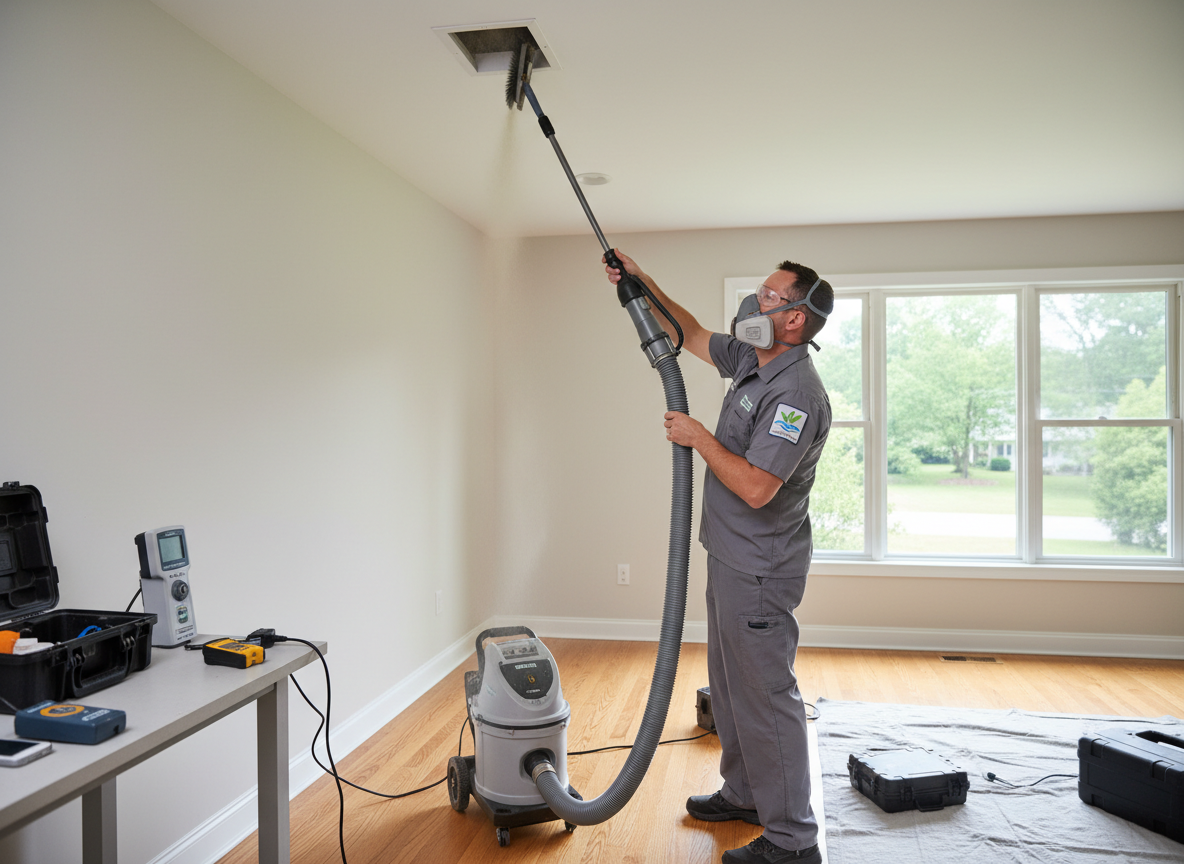
Homes in Parsippany-Troy Hills often date from the 1950s through 1970s, with original ductwork that runs through attics and crawl spaces exposed to temperature swings. These systems pull in pollen and fine dust from nearby wooded sections and Route 46 corridors, then redistribute it when furnaces cycle in winter. Proper cleaning requires accessing each branch run rather than just the main trunk to prevent recontamination after the first heating season.
Moisture from humid summers condenses inside metal ducts that lack proper insulation, especially in split-level houses common along Beverwyck Road and Lake Hiawatha. This creates conditions where dust adheres to surfaces and restricts airflow. Technicians must use negative-pressure equipment with HEPA filtration to capture debris without blowing particles back into living spaces during the process.
Residents in neighborhoods like Mount Tabor and Cedar Lake frequently report uneven heating and cooling caused by restricted returns near exterior walls. Addressing these restrictions during an indoor air quality visit involves checking damper positions and sealing gaps at boot connections that have loosened over decades of expansion and contraction.
Technician insight
In Parsippany-Troy Hills, the thing that catches most people out with indoor air quality services is how 1960s split-level homes along Beverwyck Road trap dust in long horizontal runs that never get reached by standard vacuum attachments, so the first winter after cleaning still pushes old material if those lines are missed.
Restricted Returns in Mount Tabor
A homeowner in Mount Tabor reported weak airflow from several supply vents. Inspection showed heavy dust accumulation in the return lines running through the unconditioned attic of the 1965 split-level. We isolated the system, cleaned each branch under negative pressure, and restored full airflow without disturbing the existing insulation.
How it works
- 1
Initial Assessment
Inspect all accessible duct runs, returns, and supply registers in the Parsippany-Troy Hills home to identify buildup locations and airflow restrictions.
- 2
System Isolation
Seal off sections of the HVAC system and set up negative pressure equipment to contain debris during cleaning.
- 3
Mechanical Cleaning
Use rotary brushes and compressed air tools on each branch line to dislodge dust and debris accumulated from local pollen and heating cycles.
- 4
Final Verification
Reconnect components, run the system, and confirm improved airflow through registers before leaving the property.
Pricing
Pricing depends on number of runs, access difficulty, and home size; quotes provided after on-site assessment.