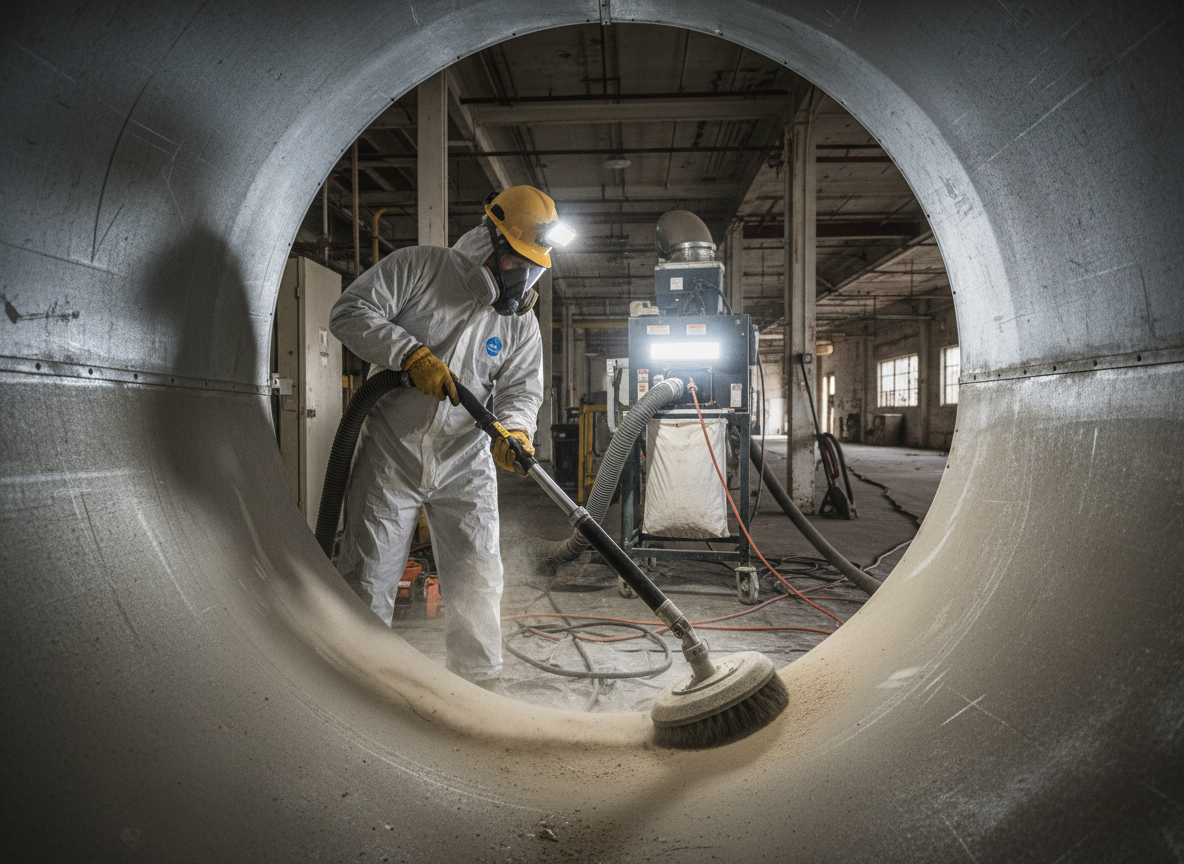
Industrial facilities in Parsippany-Troy Hills often run 24-hour operations with high air turnover that pulls in fine metal shavings, oils, and manufacturing dust. These contaminants settle deep in long trunk lines and branch runs that standard residential equipment cannot reach. Proper cleaning requires negative-air machines sized for the full system volume plus agitation tools that break up compacted material without damaging spiral or rectangular duct seams common in buildings constructed along Route 46 corridors.
Older industrial stock in the township frequently features lined ducts installed before current access standards. When liners degrade, loose fibers mix with process dust and travel into work areas. Technicians must map every access point first, then isolate zones so production can continue in adjacent spaces. Skipping isolation steps allows cross-contamination that shows up weeks later in finished goods or employee complaints.
Seasonal humidity swings in northern New Jersey cause condensation inside uninsulated roof-level ducts during spring and fall. That moisture binds with manufacturing residues to form hard cakes that reduce airflow and trigger sensor faults on rooftop units. Industrial cleaning here includes targeted drying passes and, when needed, removal of saturated liner sections rather than simple vacuuming that leaves the root problem untouched.
Technician insight
In Parsippany-Troy Hills, the thing that catches most people out with Industrial air duct cleaning is the 1970s-era lined ductwork still common in buildings near the old Ford plant site. Once the liner starts shedding, simple vacuuming just pushes fibers farther downstream and creates new IAQ complaints months later.
Parsippany Warehouse Production Line Shutdown
Fine aluminum dust from CNC machines kept triggering air-quality alarms. Inspection showed compacted residue blocking half the return runs above the assembly floor. Negative-air machines with rotary brushes cleared the trunk lines while the line stayed partially operational. After rebalancing, sensor faults stopped and the facility returned to full shifts.
How it works
- 1
System Assessment
Map all trunk lines, branches, and rooftop units while noting access points and any damaged liner sections.
- 2
Zone Isolation
Seal off work areas with temporary barriers so production can continue elsewhere in the facility.
- 3
Agitation and Extraction
Use mechanical brushes and negative-air machines sized for industrial volumes to remove compacted debris.
- 4
Post-Clean Verification
Inspect registers and return paths, then document airflow readings before restoring full system operation.
Pricing
Cost depends on duct length, number of rooftop units, and access difficulty; quotes provided after on-site assessment.