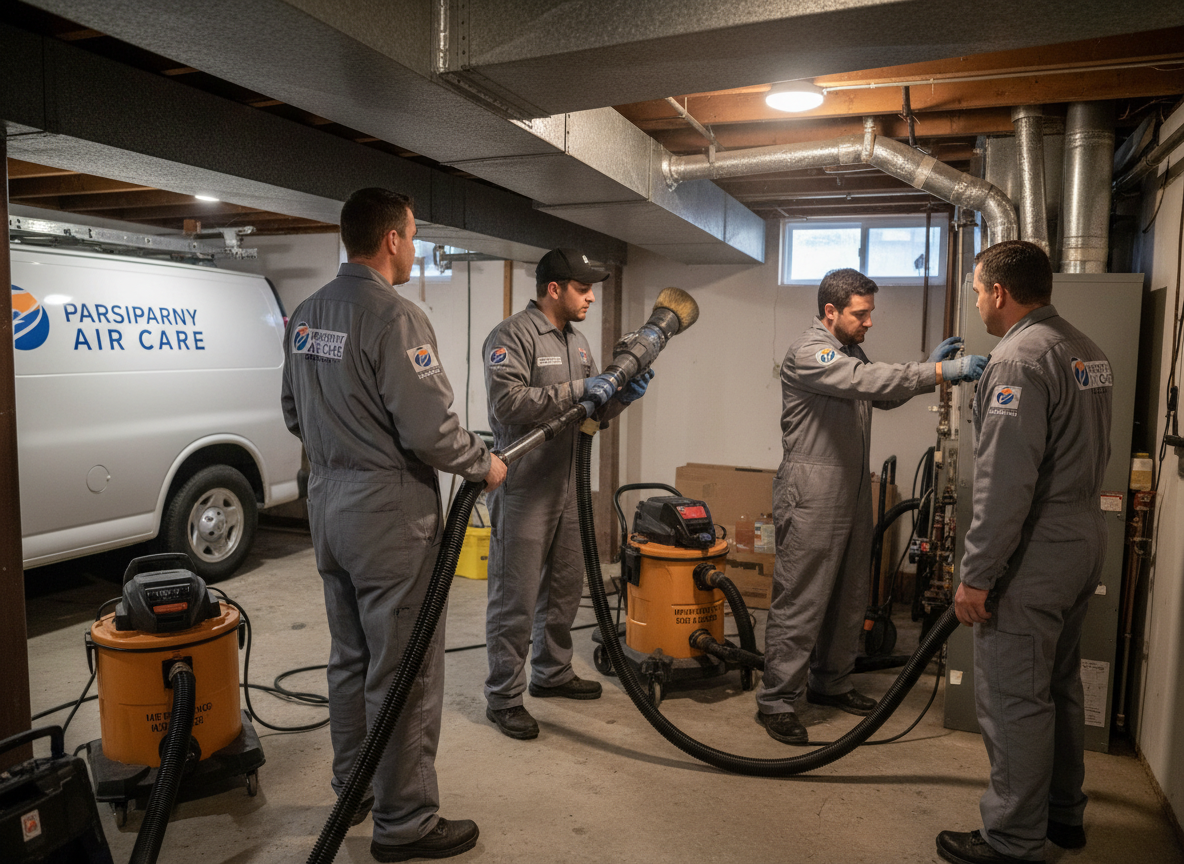
Homes in Parsippany-Troy Hills often feature duct systems installed during the 1960s through 1980s expansions around Lake Parsippany and the Route 46 corridor. These older runs collect fine silt and insulation fibers that standard vacuum tools leave behind, especially where branches turn sharply near exterior walls exposed to winter freeze-thaw cycles. Proper cleaning requires sectional agitation rods and negative-air machines sized for the longer trunk lines common in split-level and ranch layouts that dominate the area. Skipping the main return near the furnace can recirculate loosened debris back into living spaces within days.
Seasonal humidity swings in Morris County push moisture through unsealed joints, allowing mold to form on interior duct surfaces during humid summers followed by rapid drying in winter. Technicians must inspect for these conditions before brushing because aggressive cleaning on compromised fiberglass lining can release particles into the supply side. In neighborhoods like Lake Hiawatha and Powder Mill, where many homes sit on sloped lots, condensate lines from upstairs units often drain near duct chases, creating hidden wet spots that require targeted drying before any sealing work.
Access panels in finished basements or low crawl spaces under 1950s-era sections of town require careful removal of drywall or paneling to reach the main plenum without damaging surrounding framing. Homeowners frequently overlook the short vertical drops that feed second-floor bedrooms, leaving those branches untouched during quick cleanings. Full restoration includes brushing each branch to the register boot, then vacuuming the collected material through the machine so nothing settles back into the system once airflow resumes.
Technician insight
In Parsippany-Troy Hills, the thing that catches most people out with licensed and insured duct cleaners is how many 1970s split-levels around Lake Parsippany have vertical drops hidden behind finished basement walls that never get reached unless you open the wall. Homeowners assume a quick vacuum at the registers is enough, but those short runs hold the bulk of the fine silt that keeps getting pulled back into the system every heating season.
Hidden Vertical Runs in Split-Level
A homeowner in the Powder Mill section reported weak airflow on the upper floor after a recent furnace replacement. Inspection showed two short vertical drops behind a finished basement wall that had never been cleaned. We opened access points, agitated and vacuumed the lines, then resealed the wall. Airflow balanced across all registers once the job was complete.
How it works
- 1
Initial Walk-Through
Technician inspects every accessible register, return, and the furnace or air handler to map duct layout and note any visible damage or moisture.
- 2
Equipment Setup
Negative-air machine connects at the main trunk while sectional rods and brushes are staged at each branch to contain debris during agitation.
- 3
Sectional Cleaning
Each supply and return line is agitated and vacuumed starting from the farthest point and working back to the equipment to prevent cross-contamination.
- 4
Final Inspection and Reassembly
Registers are reinstalled, access points sealed, and airflow checked at multiple points to confirm the system moves air evenly again.
Pricing
Cost depends on number of stories, total linear feet of duct, and whether access panels must be cut; call for an on-site assessment.