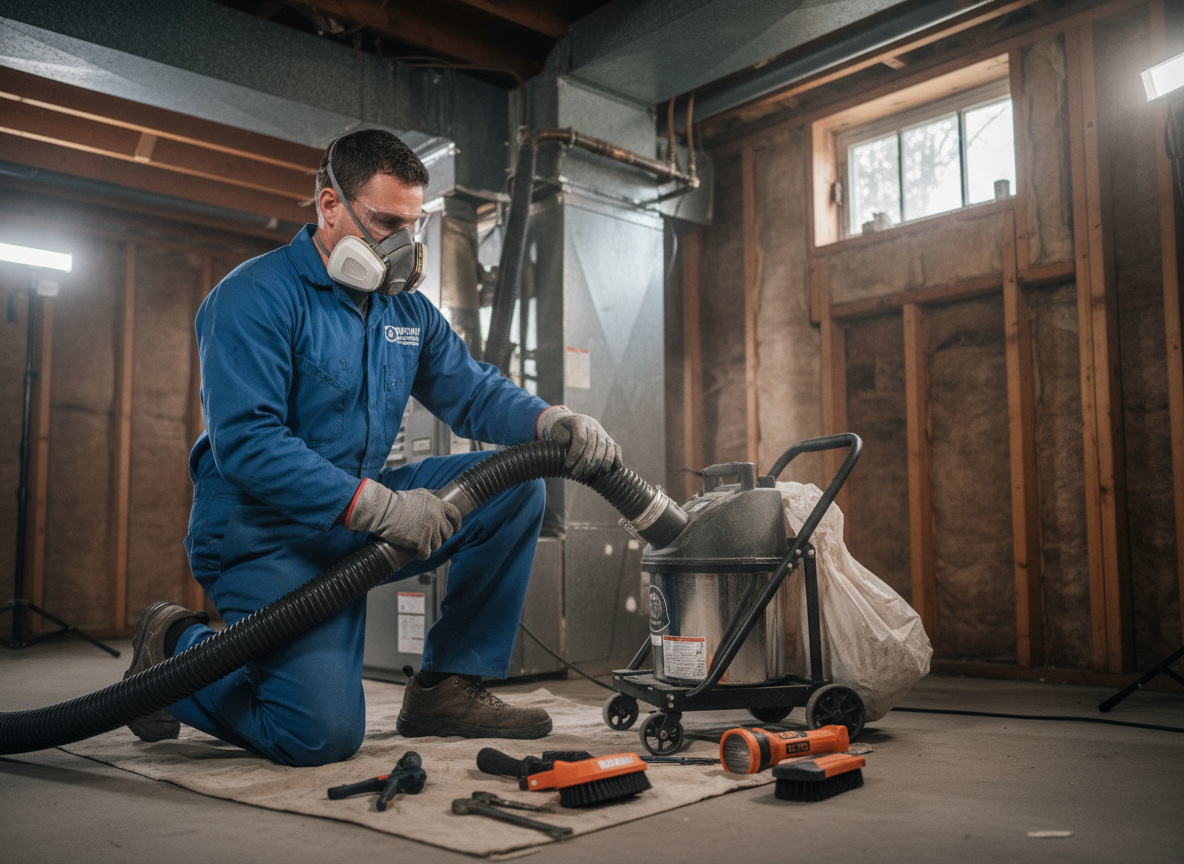
Professional duct cleaning in Parsippany-Troy Hills addresses the buildup that occurs in homes built from the 1950s onward, where original metal trunk lines and flexible branch runs collect construction dust, pet dander, and insulation fibers over decades. Technicians begin by mapping every register and return to locate sections that have settled or separated at joints, a common issue in split-level and ranch-style houses common along routes like Route 46 and Beverwyck Road. Proper sealing of the system before agitation prevents contaminants from migrating into living spaces during the process.
Equipment choice matters on the ground here because many basements sit partially below grade near the Rockaway River watershed, creating higher humidity that can turn loose dust into caked layers inside elbows and transitions. Negative-pressure machines paired with rotary brushes sized for both 6-inch and 8-inch runs reach these spots without collapsing older duct walls. After cleaning, each register is vacuumed individually and dampers are checked for free movement so airflow returns evenly across rooms on upper and lower levels.
Seasonal Considerations
Spring pollen and fall leaf debris enter through outdoor intakes and settle in the main trunk before homeowners notice reduced airflow. Winter heating cycles then bake the material in place, making spring or early fall the most effective windows for service in Parsippany-Troy Hills. Skipping these windows often means heavier agitation is required later, increasing the chance of dislodging loose insulation around duct boots.
Access Challenges
Crawlspaces under many 1960s and 1970s homes in the Lake Hiawatha section frequently lack full clearance, so technicians use remote camera inspection first to decide whether to enter or work from register openings only. This prevents unnecessary disturbance of vapor barriers and keeps insulation from being pulled into the airstream during the job.
Technician insight
In Parsippany-Troy Hills the thing that catches most people out with professional duct cleaning is the way 1960s and 1970s split-level homes have trunk lines that run through finished ceilings and then drop into shallow crawlspaces where settled dust has hardened against the metal; standard brush passes miss it unless you first isolate and camera-map every transition.
Compacted Debris in Lake Hiawatha Split-Level
Homeowner in the Lake Hiawatha section reported weak airflow from second-floor registers. Inspection showed compacted dust and insulation fibers in the main return trunk where it passed through the crawlspace. Negative-pressure equipment was set up from an exterior access panel and rotary brushes cleared the hardened material without disturbing the vapor barrier. Airflow balanced across all rooms once the system was restored.
How it works
- 1
System Mapping and Inspection
Technicians locate every supply and return opening, note duct material and condition, and identify access points that will allow full coverage without cutting into finished walls.
- 2
Isolation and Sealing
Registers are sealed and the HVAC system is isolated so negative pressure can be applied only to the ductwork, preventing dust migration into occupied rooms.
- 3
Agitation and Extraction
Rotary brushes and compressed-air tools loosen debris while a high-volume vacuum draws material out through the main trunk lines to a contained collection unit.
- 4
Final Verification
Each section is re-inspected with a camera, registers are cleaned, and the system is run to confirm balanced airflow before the home is returned to normal use.
Pricing
Cost depends on number of stories, duct material, and accessibility of trunk lines; quotes provided after on-site mapping.